
Renju: A Competitive Board Game
Classic Strategy Meets Ancient Tradition
🎮 Overview
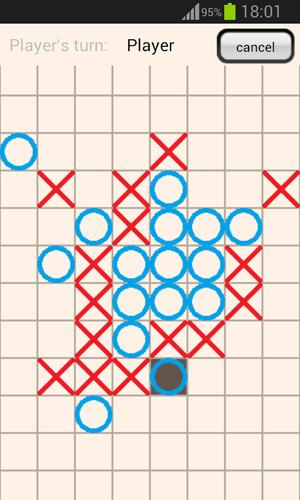
Renju is a strategic two-player board game of deep tactical depth, derived from the ancient game of Gomoku (also known as Five in a Row). It is played on a grid, where players take turns placing their markers. The goal is to form a continuous line of five of your own markers—horizontally, vertically, or diagonally—before your opponent does.
Renju introduces balanced gameplay rules to prevent the first player from having an overwhelming advantage, making it fair and competitive.
🧩 Game Setup
- Board: A standard 15×15 grid (though variants exist on 13×13 or 19×19 boards).
- Players: Two players—Player X and Player O.
- Markers: Player X uses "X", Player O uses "O".
- First Move: The first player (X) always goes first, but with restricted opening rules to maintain balance.
✅ Objective
Be the first to form an unbroken line of exactly five of your markers in any of the following directions:
- Horizontal (left to right)
- Vertical (top to bottom)
- Diagonal (up-left to down-right or down-left to up-right)
❗ Important: The line must be exactly five—if a player creates six or more in a row, it does not count as a win unless it includes a five-in-a-row that is not part of a longer line.
📌 Key Rules (Renju-Specific Enhancements)
To prevent the first player from dominating, Renju includes several balance rules:
1. Opening Rule: First Move Placement
- The first player (X) may only place their first stone on the central intersection (8,8)—the very center of the 15×15 board.
✅ Allowed: X at (8,8)
❌ Not allowed: X anywhere else on first move.
2. Second Move Rule (Double-Block Rule)
- After X plays at center, Player O has the right to place two stones on their second turn (i.e., a "double move").
- These two stones must not form a threat (like a 2-in-a-row or 3-in-a-row) that could easily lead to a win.
- However, O cannot place both stones in a way that creates a direct win or immediate threat, unless it’s a valid, balanced setup.
🛑 O cannot use this double move to win immediately or create a forced win.
3. No Overline Wins
- A player cannot win by making six or more in a row.
- If a player places a stone to extend a line beyond five, that line does not count as a win unless it contains a five-in-a-row that is not part of a longer line.
Example:
X X X X X X→ Not a win, because it's six in a row.- But if
X X X X Xis isolated (not part of a longer line), it is a win.
4. No Suicide Rule (Prohibited Moves)
- A player cannot place a stone that immediately completes five in a row if it would not be the first such line (e.g., if the opponent already had an unblocked five, or if it creates a "suicidal" win).
⚠️ This rule is mainly for fairness in competitive play.
5. Draw Condition
- If the board fills up with no five-in-a-row, and no player has won, the game is a draw.
🤝 In competitive play, draws are rare but possible. Some tournaments use sudden death or replay rules to decide.
🔄 Gameplay Flow
- Player X places their first stone at the center (8,8).
- Player O places two stones on their turn (must not violate threat rules).
- Players alternate turns placing one stone per turn.
- The first player to form exactly five in a row (in any direction) wins.
- If the board fills and no player has five in a row, the game is a draw.
🏆 Winning Conditions (Examples)
✅ Win – Horizontal:
O O O O O→ Player O wins.
✅ Win – Vertical:
X
X
X
X
X→ Player X wins.
✅ Win – Diagonal:
X
X
X
X
X→ Player X wins.
❌ No Win – 6 in a row:
X X X X X X→ Not a win (must be exactly five).
📚 Strategic Tips
- Control the center: The center (8,8) is critical—dominate it early.
- Watch for forks: Avoid creating multiple potential five-in-a-row threats unless you can block your opponent.
- Block early: Always anticipate your opponent’s ability to form a five.
- Use the double move wisely: O’s second turn is powerful—use it to block or set up traps.
🏁 Conclusion
Renju is more than just a simple "five in a row" game. With its balanced opening rules, tactical depth, and rich history, it stands as a true test of skill, patience, and foresight.
Whether played casually on a 15×15 board or in high-stakes tournaments, Renju rewards the thoughtful player.
🎮 Ready to play? Place your first stone at the center—and may the best strategist win.
Renju – Where every move shapes destiny.