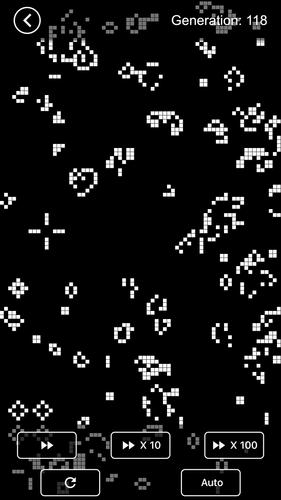

Conway's Game of Life is a groundbreaking cellular automaton created by mathematician John Conway in 1970. This zero-player game unfolds on an infinite two-dimensional grid composed of square cells, each existing in one of two possible states: alive or dead. The evolution of the system occurs in discrete time steps, known as generations, with the state of each cell in the next generation determined by a set of simple rules based on the current states of its eight neighboring cells—those adjacent horizontally, vertically, or diagonally.
The initial configuration serves as the first generation. All subsequent generations are produced by simultaneously applying the rules to every cell on the grid, meaning all births and deaths occur at once. The rules governing the lifecycle of each cell are as follows:
- A live cell remains alive in the next generation if it has exactly two or three live neighbors; otherwise, it dies due to underpopulation or overcrowding.
- A dead cell becomes alive if it has exactly three live neighbors, a condition known as reproduction.
While numerous rule variations exist—defined by different combinations of survival and birth conditions—Conway tested many before finalizing this particular set. Some alternate rules lead to rapid extinction, while others result in uncontrolled expansion across the grid. The chosen rules sit remarkably close to the threshold between stability and chaos, creating a delicate balance that fosters highly complex, emergent behaviors. As with other systems exhibiting chaotic dynamics, the most intricate and fascinating patterns often arise in this narrow transitional zone.
What's New in the Latest Version 0.2.2
Last updated on Aug 3, 2024
Conway's Game of Life is a game invented by mathematician John Conway in 1970